Description
Triaxial acceleration sensor with a measurement rate of 1600Hz
The data logger for this triaxial acceleration sensor integrates a 1600 Hz measurement rate. The sensor measures instantaneous acceleration in 3 axes, such as impacts or simply vibration. Measurements are taken at the previously indicated interval. The values from the triaxial acceleration sensor are stored on an integrated memory card. Thanks to all this, the data logger is ideal for determining acceleration in fault diagnostics, component stress tests (improving product quality), machine inspection, shock measurements, and preventative maintenance. Use this acceleration logger as an economical instrument to prevent machine downtime. Remember that you cannot recover lost production time.
Small but self-sufficient
The compact design allows the user to place the triaxial acceleration logger almost anywhere. It simply needs a small surface. The software included in the delivery allows the adjustment of the acceleration sensor and the reading of the recorded values. When a customer places an order, they will always receive the latest version of the software. This is also available in our download section. Another advantage is that even if the battery runs out, the values remain stored; meaning the user does not lose the recorded values.
Exact reconstruction of accelerations and impacts in all three axes
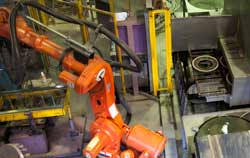
Because the triaxial acceleration sensor is integrated into the device, the range of applications for acceleration measurement increases with a high recording rate of up to 1600 Hz. The triaxial acceleration sensor can be placed on a fixed object, such as machines, motors, generators, which allows recording the state during different processes. Is it possible that a motor operates within a certain speed range during start-up or shutdown due to resonances, and that this causes strong accelerations with large loads for the machine structure and its environment? With the triaxial acceleration sensor, you can limit the corresponding ranges and additionally obtain an indication of which of the 3 axes recorded the greatest amplitude. This information is very useful, for example, in damping systems. In addition to using the triaxial acceleration sensor for fixed installations, you can also mount it on moving objects. This will allow you to detect shocks, impacts, and accelerations of objects in 3 axes, which you can analyze graphically and numerically. You will also be able to detect small displacements and tilting movements in three-dimensional spaces. This is possible thanks to its high resolution. The triaxial acceleration sensor is suitable for many applications in the transport and industrial sectors.
To clearly visualize the acceleration of the 3 axes with high resolution over a period of time, it is necessary to obtain many values with an exact date and time. Only then can you accurately visualize and analyze the actual course in a diagram with the corresponding axes for acceleration and time. The triaxial acceleration sensor from PCE Instruments allows you to do just this. Thanks to its high recording rate of 1600 Hz, this triaxial acceleration sensor is especially suitable for recording oscillations or vibrations of higher frequency or very short impact or shock impulses. For example, if you need to record periodic vibrations of a high frequency, and then visualize them accurately and without distortion, it will be necessary to set a high recording rate. The same applies to impacts or shocks. Extremely short load peaks will only be visible if many values are recorded in a short period of time. The triaxial acceleration sensor from PCE Instruments makes this possible. With a recording rate of 1600 Hz, the data logger can record a value every 0.4 milliseconds. This allows very rapid mechanical loads to be made visible. With the help of a Damage Boundary Curve (DBC), you can correctly classify these impact loads on each of the 3 axes, which will allow you to provide proof of possible damage to machines, products, installations, or goods during transport.
- 3-axis acceleration up to 1600 Hz
- 32 GB SD memory card
- Small dimensions: 86.8 x 44.1 x 22.2 mm
- Made in Germany
| Parameter: Triaxial acceleration |
| Range |
±16 g |
| Accuracy |
±0.24 g |
| Recording rate |
1600 Hz ... 1 Hz |
| |
|
| General technical specifications |
| Memory capacity |
2.5 million values per measurement,
3.2 billion values with 32 GB micro SD card |
| Keys |
1 x key: Start / Stop a measurement
1 x key: Turn data logger on or off |
| LEDs |
Log: Operating status
Alarm: Alarm indicator
Charge: Battery status indicator
USB: PC connection status |
| Power supply |
Integrated Li-Ion battery 3.7 V / 500 mAh
Battery is charged via the USB port |
| Integrated sensors |
Triaxial acceleration |
| Interface |
USB |
| Software |
Free data logging and analysis software (Windows XP / Vista / 7 / 8 / 10 32 Bit / 64 Bit) |
| Operating conditions |
Temperature -20 ... +65 °C |
| Storage conditions |
Temperature: +5 ... +45 °C (ideal battery conditions)
10 ... 95 % RH, non-condensing |
| Standards |
The PCE-VDL 24I complies with the EU RoHS/WEEE directive |
| Weight |
Approx. 60 g |
| Dimensions |
87 x 44 x 23 mm |
1 x PCE-VDL 24I Data Logger
1 x USB - Micro USB data cable
1 x 32 GB micro SD memory card
1 x Card insertion/extraction tool
1 x USB stick with analysis software and instruction manual


